

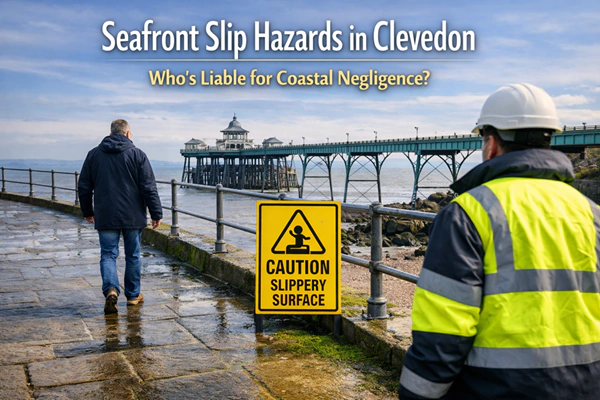
A slip on a seafront walkway does not always mean the same thing from one location to another. In coastal towns, the cause of the hazard, who controls the area, and how long the risk has existed can all change how responsibility is viewed.
In places like Clevedon, this distinction matters more than most people realise. Seafront paths, promenades, and surrounding businesses operate in an environment shaped by weather, sea exposure, and constant public use. That creates risks which are not always obvious, but also not always unavoidable.
The assessment of these situations hinges on understanding whether a slip results from natural conditions or manageable factors.
Why coastal environments create different risks
Surfaces near the sea behave differently to inland walkways. Saltwater exposure, wind, and temperature changes all affect how materials wear over time. Moisture can settle quickly, even when conditions appear dry, and algae can form in areas that receive little direct sunlight.
This means a walkway that looks safe at a glance may carry a level of risk that is not immediately visible. The key issue is not that coastal hazards exist, but whether they are recognised and managed appropriately.
Public seafront areas vs. privately operated spaces
In Clevedon, responsibility often depends on who controls the area where the incident occurred.
- Public areas, such as promenades or council-maintained paths, are generally subject to inspection and maintenance schedules. These may take into account environmental conditions, but they also operate within practical limits. Weather-induced sudden changes may not always receive immediate attention.
- Privately operated spaces, such as cafés, shops, or attractions along the seafront, usually have more direct control over their immediate surroundings. This can include entrance areas, outdoor seating, and access points where customers are expected to move through safely.
The distinction is not about one being automatically responsible while the other is exempt. It is about what level of control existed and how that control was used to manage risk.
Naturally occurring hazards vs. preventable hazards
Not all seafront hazards are treated the same way.
- Naturally occurring conditions include sea spray, damp surfaces after changes in weather, and gradual algae build-up in exposed areas. These can develop quickly and may not always be preventable in the moment.
- Preventable hazards tend to involve situations where a known issue has not been addressed. This might include a surface that has become consistently slippery over time, or a lack of warning signage in an area where people are expected to walk.
The distinction between these two categories often hinges on awareness and response, rather than the hazard itself.
Temporary risk vs. on-going hazard
Timing also plays a role in how a situation is viewed.
- Temporary risks may appear suddenly, such as after a period of heavy sea spray or rainfall. In these cases, the question often centres on how quickly the condition could have been reasonably identified and addressed.
- On-going hazards develop over a longer period. Repeated exposure to moisture, combined with limited maintenance, can create surfaces that remain slippery for extended periods. Where a risk has been present for some time, the expectation that it should have been managed becomes stronger.
Example comparison: How similar incidents can be viewed differently
Situation A:
A section of promenade becomes wet following strong coastal winds. The area was inspected earlier that day, and there is no history of previous incidents in that location. A passer-by slips shortly after conditions change.
Situation B:
An area outside a seafront café has visible algae build-up that has developed over time. Customers regularly pass through the same entrance point. There are no warning signs, and no recent evidence of cleaning or treatment.
The incidents may appear similar at the point of injury, but the surrounding factors differ. In the first situation, the condition is recent and linked to environmental change. In the second, the risk has developed over time and may have been identifiable before the incident occurred.
This difference influences how responsibility is examined.
What usually influences liability in seafront accidents?
- How long the surface condition had been present
- Whether inspections or maintenance were carried out
- How visible or obvious the hazard was
- Whether warnings were in place where appropriate
- The level of control over the area where the incident occurred
- Whether alternative safer routes were available
- Any history of similar incidents in the same location
These factors are not considered in isolation. They are used together to understand whether the situation could reasonably have been managed more effectively.
Why seafront claims are often misunderstood
There is a common assumption that if a hazard is caused by natural conditions, there is no basis for further consideration. That is not always accurate.
Coastal environments are expected to present certain risks, but they are also expected to be maintained and monitored. The presence of a natural factor does not remove the need to manage its effects where possible.
The focus is not on eliminating every hazard, but on whether reasonable steps were taken to reduce foreseeable risk.
This is where cases can become more nuanced, and why firms such as Marley Solicitors are often involved in situations where the distinction between natural and preventable risk is not immediately clear.
What matters after a slip in Clevedon?
The details surrounding the incident are often as important as the incident itself.
Conditions at the time, including weather and visibility, can help explain how the hazard developed. Photographs of the surface and surrounding area may capture details that change quickly. Reporting the incident creates a formal record, which can be crucial if the condition changes shortly thereafter.
Understanding exactly where the incident occurred is also key, as responsibility may differ depending on whether the area was publicly maintained or privately controlled.
Understanding the difference between unavoidable and unmanaged risk
Seafront environments like Clevedon will always carry some level of natural risk. The critical distinction is whether that risk was simply present, or whether it had reached a point where it should have been addressed.
Recognising that difference is what shapes how these situations are interpreted. It moves the focus away from the fact that an accident happened, and towards whether the conditions leading up to it were handled in a way that was reasonable given the environment.