

Holiday parks are designed to feel relaxed. People arrive expecting a break from routine, not an environment that requires constant awareness of risk. That shift in mindset matters more than it first appears.
In places like Minehead, holiday parks combine accommodation, entertainment, and shared facilities within a single site. Guests move between lodges, restaurants, activity zones, and open spaces throughout the day and into the evening. Each of those movements passes through areas that are not always clearly defined in terms of responsibility.
The result is an environment where risk is not concentrated in one place. It is spread across multiple layers, often making it less visible until something goes wrong.
Why holiday park environments create layered risk
Unlike a single-purpose venue, a holiday park operates as a network of connected spaces. Accommodation areas may be separate from central facilities, requiring guests to walk across shared paths or through transitional zones. Lighting conditions can vary depending on location and time of day. Surfaces may change between paved routes, grass, decking, or temporary coverings.
Facilities such as swimming pools, entertainment venues, and outdoor activity areas introduce their own sets of conditions. Movement between these areas is constant, particularly during peak periods when guests are following similar schedules.
This structure means that risk does not sit in isolation. It builds through the interaction between spaces, especially where design, maintenance, and usage patterns overlap.
How responsibility becomes fragmented
One of the defining features of holiday park incidents is that responsibility is rarely held by a single party.
The site operator typically oversees the wider environment, including infrastructure, layout, and general safety management. However, either the operator or third-party providers may maintain individual accommodation units separately. Activities offered on site, such as water sports or organised entertainment, may involve external contractors.
Maintenance itself can be split across teams. A pathway issue might fall under general site upkeep, while lighting problems could involve a different contractor. When these elements intersect, identifying who was responsible for a specific condition at a specific time becomes less straightforward.
This layered structure is why cases in these environments often require careful analysis. Legal teams such as Marley Solicitors frequently assess how these responsibilities connect, particularly where an incident appears to result from gaps between different areas of control.
A practical scenario within a Minehead holiday park
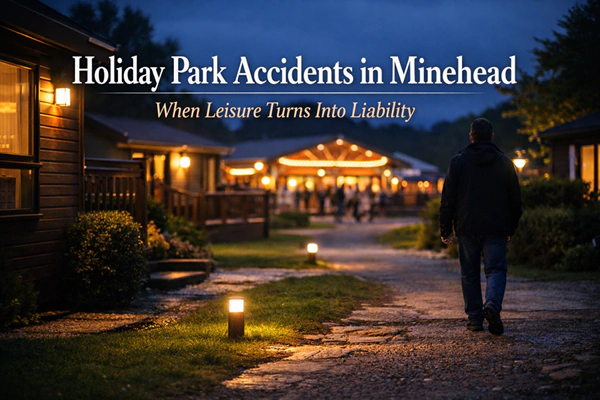
A guest leaves their accommodation in the evening to walk towards a central entertainment venue. The route is familiar and was used earlier in the day without issue.
As conditions change, the pathway becomes less visible. Lighting along the route is inconsistent, with darker sections between illuminated areas. The surface itself is slightly uneven, and foot traffic throughout the day has contributed to minor wear in certain spots.
While walking through one of the darker sections, the guest misjudges the surface and trips, falling forward and sustaining an injury.
The incident appears simple, but the underlying question is more complex. The issue is not just the fall itself, but which part of the system failed. Was the pathway adequately maintained? Was the lighting sufficient for safe movement? Was there a known issue that had not been addressed?
These questions sit across different layers of responsibility.
Common risk points within holiday parks
- Poor lighting between accommodation areas and central facilities
- Uneven or worn pathways that change under sustained foot traffic
- Delays in addressing maintenance issues within shared spaces
- Transitional areas where surfaces or layouts shift without clear indication
- Lack of signage in areas where visibility is reduced
- Overlap between activity zones and general walkways
- High-traffic routes not monitored consistently during peak periods
Each of these points reflects how risk can develop gradually within a connected environment. They are rarely isolated problems. More often, they combine in ways that increase the likelihood of an incident.
Why leisure environments are often underestimated
The perception of safety plays a significant role in how people behave within holiday parks. Guests are less likely to approach the environment with the same level of caution they might use in a workplace or unfamiliar setting. That reduced awareness can influence how risks are encountered.
At the same time, operators must manage a wide range of conditions across the site. Balancing guest experience with practical safety considerations is not always straightforward, particularly in environments that are designed to feel open and accessible.
This combination can lead to situations where hazards are not immediately recognised or prioritised, even when they are capable of being addressed.
What determines whether a situation can be challenged
In incidents like these, the focus usually turns to three core points: control, awareness, and response.
Control relates to who was responsible for the area where the incident occurred. In a holiday park, this may not be obvious at first glance. It often requires looking at how the site is managed and who is responsible for specific elements within it.
Awareness considers whether the risk was known, or should reasonably have been known. This can involve previous reports, visible signs of wear, or conditions that had developed over time.
The response looks at what was done once the risk was identified. If a hazard was present, the question becomes whether reasonable steps were taken to address it within an appropriate timeframe.
These factors are not assessed in isolation. They are used together to understand whether the environment was managed in a way that reduced foreseeable risk.
Why these cases require a structured view
Holiday park incidents can appear straightforward at the point they occur. A trip, a slip, or a fall may seem like an isolated event. When placed within the wider structure of the site, the situation often becomes more layered.
Understanding how different areas of responsibility interact is key. It allows the focus to move beyond the immediate outcome and towards the conditions that led to it.
In a setting like Minehead, where leisure, accommodation, and shared facilities operate together, that structured view is often the only way to fully understand how and why an incident happened.