

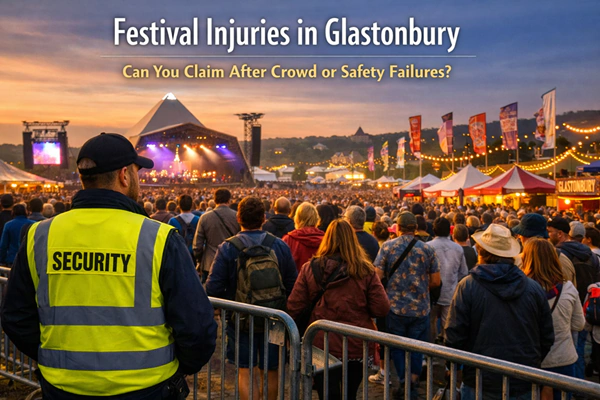
Arrival starts early. People move through entry points in waves, carrying equipment, navigating queues, and adjusting to the scale of the site. Movement is steady, but controlled. Routes are visible, and there is space to reposition if needed.
As the day progresses, that space begins to change. Footfall increases, movement becomes less predictable, and pathways that once felt open start to narrow. By the time peak hours arrive, the environment operates very differently from how it began.
In a setting like Glastonbury Festival, injuries rarely come from a single moment in isolation. They develop through a sequence of changes that build pressure over time.
How festival injuries typically develop over time
Early in the day, entry and movement tend to follow expected patterns. Attendees spread across the site, and access routes remain usable. Staff presence is visible, and direction is relatively clear.
By mid-event, the dynamic shifts. Movement between stages increases, particularly when schedules overlap or popular acts draw large crowds. Foot traffic becomes less evenly distributed, and certain routes begin to carry more pressure than others.
As peak periods approach, density increases further. Movement slows, and in some areas, it becomes restricted. Visibility drops as the crowd tightens, making it harder to anticipate obstacles or changes in direction. At this stage, the environment is less responsive. Individuals have less control over their own movement.
The incident point often emerges from this pressure. A shift in the crowd, a change in footing, or a sudden stop can cause a loss of balance. When space is limited, the ability to recover is reduced, and a fall or collision can follow.
The immediate aftermath can be equally important. Access for assistance may be restricted, and delays in response can occur if routes are blocked or unclear. What began as a manageable situation earlier in the day can become significantly more difficult to control.
A timeline scenario: movement between stages at peak time
A person moves from one stage to another during a busy transition period. The route they take is familiar, having used it earlier in the day without issue.
As they approach a central pathway, the density increases. Movement slows, and the flow becomes uneven. People stop and start without warning, and the available space narrows as others gather along the edges.
Further along the route, the surface changes slightly. What was a stable walking area earlier now feels less secure underfoot, partly due to wear from constant use and partly due to limited visibility in the growing crowd.
As pressure builds from behind, the individual is forced forward. There is little room to adjust. A momentary loss of balance leads to a fall, with others unable to stop quickly enough to avoid contact.
Looking back at the sequence, the fall is only one part of the picture. The conditions that led to it were already developing through the earlier stages of the event.
Where risk begins to escalate
The key factor in situations like this is not simply crowd size, but how that crowd is managed as it evolves.
Routes that function effectively at lower density may not perform the same way under pressure. Areas that appear safe during initial planning may become high-risk zones as movement patterns change. The interaction between layout, timing, and behaviour creates points where risk increases gradually rather than appearing suddenly.
This is where large-scale events differ from smaller gatherings. The margin for error becomes narrower, and the impact of small issues becomes more pronounced.
Legal teams such as Marley Solicitors often review these types of incidents by looking at how conditions developed, rather than focusing only on the final moment when the injury occurred.
Key risk factors that influence festival injury claims
- Crowd density reaching levels where safe movement is restricted
- Poorly managed transition routes between major areas of the site
- Temporary structures affecting visibility or altering natural pathways
- Uneven or unstable ground conditions under sustained foot traffic
- Inadequate lighting in areas with high evening movement
- Delayed response to developing congestion in known pressure zones
- Insufficient staff positioned where crowd flow begins to slow
- Lack of clear directional guidance during peak periods
- Restricted access routes for assistance or emergency response
- Failure to adjust layouts or controls as attendance patterns shift
- Known high-traffic areas not actively monitored throughout the event
- Communication gaps between teams responsible for different sections of the site
Each of these factors can contribute to how an incident develops. They are not considered individually, but as part of the wider environment in which the injury occurred.
Why large festivals increase complexity
Scale changes how risk operates. At an event the size of Glastonbury, there are multiple stages, overlapping schedules, and continuous movement across large distances. This creates a network of interactions that is difficult to control in a static way.
Different areas of the site may be managed by different teams. Contractors, organisers, and support staff all play a role in how the environment functions. Coordination between these groups becomes essential, particularly during peak periods when conditions are changing quickly.
The challenge is not only in planning for expected behaviour, but in adapting to real-time changes. As patterns shift, the ability to respond effectively can influence how situations develop.
What matters after a festival injury
After an incident, the timing and location become central to understanding what happened. Identifying where on the site the injury occurred, and at what stage of the event, helps place it within the broader context of crowd movement and conditions.
Details about the surrounding environment can also be relevant. This includes how dense the crowd was, whether movement was restricted, and what the surface conditions were at the time. These elements can change rapidly, so capturing them as accurately as possible is important.
Reporting the incident creates a record that links the event to the conditions in which it occurred. Without that, reconstructing the situation later can become more difficult.
Understanding how incidents build over time
In large festival environments, injuries rarely appear without warning. They tend to emerge from a sequence of changes that reduce control and increase pressure within the space.
Recognising how those changes occur, and how they influence movement, is key to understanding why incidents happen. It shifts the focus away from a single moment and towards the environment that developed around it.
In a setting like Glastonbury, that progression is often the difference between a manageable situation and one where the risk has already escalated beyond easy control.