

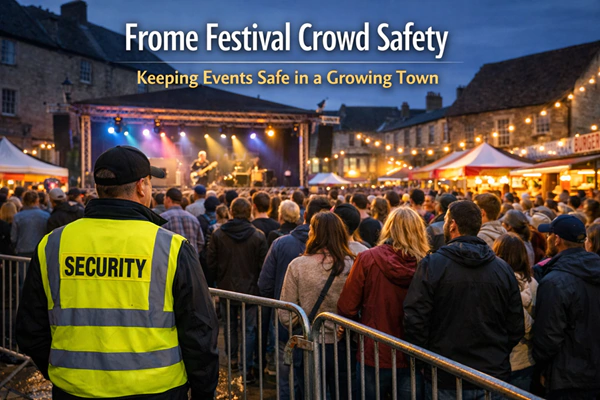
The crowd builds steadily as the evening sets in. A temporary stage sits at the centre of a busy square in Frome, with food stalls lining the edges and people moving between them. Space becomes tighter as more attendees arrive. Movement slows, visibility drops, and the layout begins to feel less controlled.
Near the front of the stage, a narrow access route becomes congested. What was meant to be a clear walkway is now blocked intermittently. As pressure builds from behind, someone is pushed off balance. There is nowhere to step safely, and they fall, hitting the ground hard against a temporary barrier.
The incident happens quickly. The conditions leading to it developed over time.
What actually went wrong
Looking at the situation in isolation can make it seem like an unfortunate accident. When broken down, it becomes clearer that multiple elements contributed to the outcome.
The layout of the event space played a role. Routes intended for movement turned into gathering areas, leading to unmanaged bottlenecks. Temporary structures, including barriers and staging, influenced how the crowd flowed through the area, sometimes redirecting movement in ways that were not obvious until the space filled.
There is also the question of supervision. As attendance increased, the environment required active monitoring. Without clear oversight, small changes in crowd behaviour can escalate to pressure points that are difficult to control. Staff positioning becomes critical here. If key areas are left unmanaged, risks can develop without being noticed early.
Planning decisions sit behind these issues. If event planners do not clearly define or enforce access routes, the wider crowd tends to absorb them. Once that happens, restoring safe movement becomes far more difficult. The same applies to entry and exit points, which may work effectively at lower capacity but struggle when demand increases.
How event responsibility is assessed
Events involve more than one party, and responsibility is rarely concentrated in a single role.
The organisers are generally responsible for overall planning, including how the space is designed and how risks are identified in advance. Venues may influence structural elements such as entry points, exits, and fixed features within the space. Contractors may be involved in staging, lighting, or temporary installations that affect how people move around.
In a situation like this, the focus is not only on the moment of the incident. It also considers the event’s design, expected risks, and the appropriateness of the measures for the crowd’s size and nature.
It also includes how conditions were managed as the event progressed. Even where planning is in place, environments change. The ability to respond to those changes in real time can influence how responsibility is viewed.
Legal teams such as Marley Solicitors often examine how these layers interact, particularly where an incident appears to result from a combination of planning and real-time management decisions rather than a single failure.
Where event safety failures commonly occur
- Inadequate assessment of how crowds will move through the space
- Access routes that are not clearly maintained during peak periods
- Insufficient staffing to monitor and guide attendee flow
- Temporary structures placed without full consideration of movement patterns
- Limited visibility in key areas due to lighting or layout
- Lack of clear communication about entry and exit routes
- Delays in responding to developing congestion
These issues are not always obvious at the start of an event. They tend to emerge as conditions change, particularly as attendance increases and movement becomes more restricted.
Why event injuries are often preventable
Large gatherings are dynamic by nature, but they are not unpredictable. Crowd behaviour follows patterns, especially in enclosed or structured spaces. Failure to account for those patterns in planning can lead to pressure building in ways that result in incidents.
Preventative measures do not rely on removing all risk. They focus on anticipating how people will use the space and adjusting the environment to accommodate that movement safely. This can include maintaining clear pathways, positioning staff where they can intervene early, and ensuring that temporary installations do not create unintended obstacles.
It can also involve reviewing previous events. If similar layouts have created issues before, that information becomes relevant. Ignoring known patterns increases the likelihood of repeat incidents.
When these elements are overlooked, the environment can shift from controlled to reactive, increasing the likelihood of injury.
What changes as the crowd grows
One of the most overlooked aspects of event safety is how conditions evolve as attendance increases.
A layout that appears spacious early in the day can become restrictive later. Walking routes may narrow as people stop and gather. Noise levels can make communication more difficult, reducing the effectiveness of verbal guidance from staff. Lighting that seemed adequate in daylight may become insufficient as visibility drops.
These shifts are predictable, even if the exact timing varies. Planning that does not account for peak conditions can lead to organisers responding to problems rather than preventing them.
In the Frome scenario, the access route did not suddenly become unsafe. It gradually lost its function as a pathway, turning into a point of congestion. By the time the risk became obvious, the space was already under pressure.
What matters after an event injury
The immediate priority is always to deal with the injury itself, but the surrounding details can become important later.
Recording the location of the incident, noting the conditions at the time, and identifying any contributing factors can help establish how the situation developed. Capturing the scene as it was can be relevant, as events change quickly and layouts may alter soon after an incident.
It’s also helpful to determine who was in charge of different parts of the event, as an attendee may not see it right away. Understanding whether the area was managed by organisers, venue staff, or contractors can influence how it is assessed.
Photographs, when appropriate, can offer context that written reports alone may not capture. Details such as barrier placement, crowd density, and lighting conditions can all help clarify what happened.
When small failures become larger risks
Incidents at events rarely stem from a single, isolated issue. They are often the result of small gaps that align at the wrong time. A layout that works at lower capacity may struggle under pressure. A route that appears clear early on may become obstructed as the crowd grows.
Recognising how these changes occur, and how quickly they can escalate, is central to understanding why injuries happen in environments that initially seem well organised.
In settings like Frome’s events and festivals, safety depends not just on planning, but on how that plan holds up as conditions change. When it does not, the consequences tend to emerge in ways that feel sudden, even though the underlying risks were building throughout the event.