

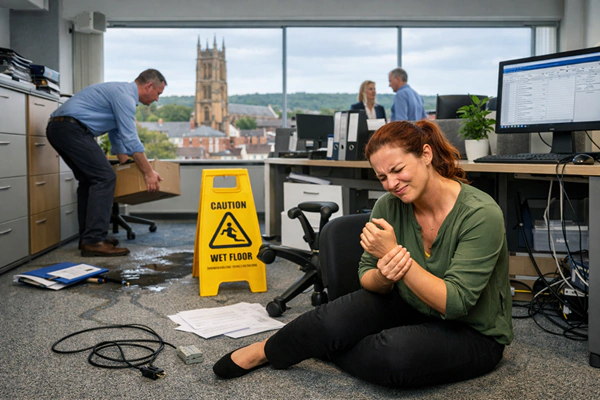
Office environments are often treated as low risk. Compared to industrial settings, they appear controlled, predictable, and safe by default. That assumption is where problems begin.
In workplaces across Taunton injuries still occur in office settings, but they rarely look dramatic. They tend to build over time or happen in moments that seem minor at first. Because of that, they are often dismissed or not examined properly.
The more useful question is not whether an injury happened, but whether the situation meets the threshold where it should be taken seriously.
Why office environments are often misunderstood
Risk in an office does not usually come from obvious hazards. It comes from repetition, layout, and small environmental issues that are easy to ignore.
A workstation used for long periods without adjustment can lead to strain. A walkway that appears clear may still contain minor obstructions. Lighting that feels adequate may still affect visibility in certain areas. None of these issues stand out individually, but over time they can create conditions where injury becomes more likely.
Because these risks develop gradually, they are often normalised. People adapt to them rather than questioning whether they should be addressed.
When does an office injury become actionable?
Not every incident or discomfort leads to a situation that can be challenged. A clearer way to understand the issue is to apply a structured filter.
- Was there a hazard present?
The first step is identifying whether the environment contained a genuine hazard.
This goes beyond personal discomfort. A hazard usually involves something within the workspace that introduces risk, such as unsafe layout, equipment placement, or conditions that affect how tasks are carried out.
For example, a cable running across a walkway or a workstation that forces awkward positioning may indicate a hazard within the environment rather than an isolated issue.
- Was the risk preventable?
The next question is whether reasonable steps could have reduced or removed that risk.
In office settings, many issues are manageable. Adjusting workstation setup, improving layout, or addressing minor maintenance problems can often reduce the likelihood of injury. The relevance of a risk arises if one could have identified and addressed it without significant difficulty.
This criterion does not mean every situation should have been prevented. It focuses on whether there was a practical opportunity to improve conditions before the incident occurred.
- Was responsibility clear?
Finally, it is important to consider who controlled the environment.
Employers are typically responsible for maintaining safe working conditions, including layout, equipment, and general workspace management. The organisation and maintenance of that space often determine the responsibility for any existing hazards.
At the same time, individual behaviour can also play a role. If established processes are ignored without reason, that may influence how a situation is viewed. The key point is whether the environment itself contributed to the outcome.
Legal teams like Marley Solicitors often employ this structured approach to evaluate whether an office-based situation warrants further action.
Applying the framework in a real office scenario
Consider a desk-based worker who begins to experience discomfort in their wrist and forearm over time. The workstation has not been adjusted since they started in the role, and the positioning of the keyboard requires a slight but consistent strain.
Applying the first step, there may be a hazard if the setup encourages poor posture or repeated strain. The issue is not the task itself, but how it is being carried out within that environment.
The second step may offer a way to prevent the risk. Adjustments to the workstation, equipment positioning, or guidance on setup could reduce the strain significantly.
The third step considers responsibility. The wider context includes the provision and maintenance of the workspace without appropriate assessment or adjustment.
This example demonstrates how a gradually developing issue can still undergo structured examination.
Where office risks are commonly overlooked
Office environments tend to hide risk within everyday routines.
Repetitive tasks can place strain on the same parts of the body over long periods. Minor layout issues can disrupt movement without being obvious hazards. Small obstructions can develop in shared spaces, such as corridors or storage areas, without immediate attention.
These issues often go unnoticed because they do not interrupt work in a visible way. Instead, they build over time or create conditions where a momentary lapse leads to an incident, such as a trip or fall, which can result in injury or damage.
Obvious danger does not always mean safety.
Common office risk triggers that are often missed
- Poor workstation setup leading to sustained strain on wrists, shoulders, or back
- Trip hazards created by cables, equipment, or storage within walkways
- Inadequate lighting affecting visibility in transitional or shared areas
- Equipment placement that interferes with natural movement patterns
These triggers are not unusual. What matters is whether they are identified and addressed as part of maintaining the workspace.
What determines whether a situation progresses
Once an incident has occurred, the focus shifts to how clearly the situation can be understood.
Evidence plays a role, but it is not limited to formal documentation. The consistency of the issue is important. If a condition has been present for some time, or if similar concerns have been raised previously, that can influence how the situation is viewed.
The environment itself is also central. Knowing how the workspace was set up, used, and reviewed helps clarify what happened.
Context matters. An office injury is usually explained by more than a single moment. It is usually part of a wider pattern.
Understanding thresholds rather than assumptions
Office injuries are often dismissed because they do not fit the usual idea of workplace risk. They develop quietly, without obvious warning, and are easy to overlook until they begin to affect normal activity.
Using a structured approach changes how these situations are viewed. It shifts the focus away from assumptions and towards clear criteria: whether a hazard existed, whether it could have been addressed, and who was responsible for the environment.
In a setting like Taunton’s office workplaces, that clarity is what separates a minor issue from one that requires closer examination.