

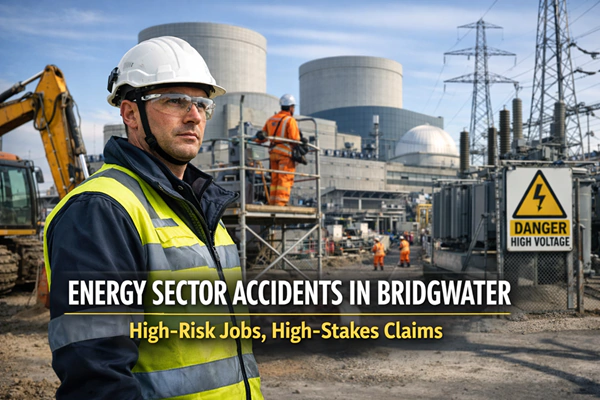
Bridgwater has become a key location for large-scale energy and infrastructure projects. With that comes a different level of workplace risk compared to standard environments.
Heavy machinery, complex systems, and high-pressure operations create conditions where accidents at work are less frequent, but often far more serious when they occur.
In this setting, injuries are rarely straightforward. Understanding what happened, and who may be responsible, usually requires a structured breakdown of the environment, the task, and the systems in place at the time.
Why Bridgwater’s energy sector creates higher-risk environments
Industrial sites in and around Bridgwater operate at a scale that introduces multiple layers of risk. Moving machinery, elevated platforms, confined spaces, or electrical systems that require strict safety controls may expose workers.
These are not unpredictable environments, but they are highly dependent on correct procedures, maintenance, and coordination. When something fails within that system, the consequences can escalate quickly.
The 4 main accident types in Bridgwater’s energy sector
1. Equipment and machinery failure
Mechanical systems are central to energy operations. Improper maintenance or faults in equipment increase the risk of sudden failure.
Injury may occur during operation, inspection, or repair. The key issue in these cases is often whether maintenance schedules were followed and whether known defects were addressed within a reasonable timeframe.
2. Falls from height on industrial sites
Many roles involve working above ground level, whether on scaffolding, platforms, or structural frameworks.
Falls can result from inadequate safety barriers, unstable surfaces, or improper use of protective equipment. The question typically revolves around the presence of appropriate safeguards for the task at hand.
3. Electrical and technical hazards
Energy sites involve high-voltage systems and complex electrical infrastructure. Contact with live components or faults in isolation procedures can lead to serious injury.
These situations often require detailed technical review to understand whether safety protocols were properly implemented and followed.
4. Site transport and movement incidents
Large sites rely on constant movement of vehicles, equipment, and materials. Limited visibility or poorly defined traffic management systems can lead to collisions or contact incidents.
Responsibility may depend on site layout, supervision, and whether clear guidance was provided to those working in the area.
Example: maintenance contractor injury on site
A contractor is assigned to carry out routine maintenance on a piece of equipment within a Bridgwater facility. During the process, a fault occurs that causes a sudden release of force, resulting in injury.
The analysis does not end with the incident itself. It moves into specific questions:
- Was the equipment inspected before the task began
- Were any known issues recorded but left unresolved
- Was the contractor given accurate information about the condition of the machinery
- Were appropriate safety procedures in place for that type of maintenance
The answers to these points shape how responsibility may be interpreted.
Why these claims are often more complex
Energy sector incidents rarely involve a single point of failure. Instead, they tend to sit within a chain of decisions, actions, and systems.
An employer may be responsible for overall safety, but contractors, equipment suppliers, and site operators may also play a role. Understanding how these responsibilities interact requires careful examination of the working environment.
The level of technical detail involved also means that evidence is not always obvious. Documentation, maintenance records, and internal procedures often become central to understanding what went wrong, as they provide crucial insights into the circumstances leading to the incident and help establish accountability.
What strengthens a workplace injury claim
- The incident was formally reported and recorded
- There is a clear link between the task and the injury
- Site records or maintenance logs support the timeline
- Witness accounts or supervisor input confirm the conditions
These factors help build a clearer picture of how the incident developed and whether it could have been prevented.
The role of specialist legal support
Cases involving industrial environments often require a more detailed approach than standard workplace incidents. Firms such as Marley Solicitors handle claims where multiple parties and technical factors are involved, helping to assess how responsibility may be distributed based on the available evidence.
What matters immediately after an incident
After an accident, the primary focus is typically on medical attention and stabilising the situation. Beyond that, it becomes important to make sure the incident is properly documented.
This includes reporting the injury through the correct internal channels and noting the circumstances as accurately as possible. Where possible, retaining details about the task being carried out, the equipment involved, and the surrounding conditions can be valuable later.
Even small details can become relevant when reconstructing how an incident occurred within a complex environment.
Understanding the structure behind high-risk claims
The moment something goes wrong does not solely define accidents in Bridgwater’s energy sector. They are shaped by the systems that were in place before it happened.
When those systems break down, the impact can be significant. Understanding how the risk was managed, and whether it was handled appropriately, is central to determining how these cases are approached.