

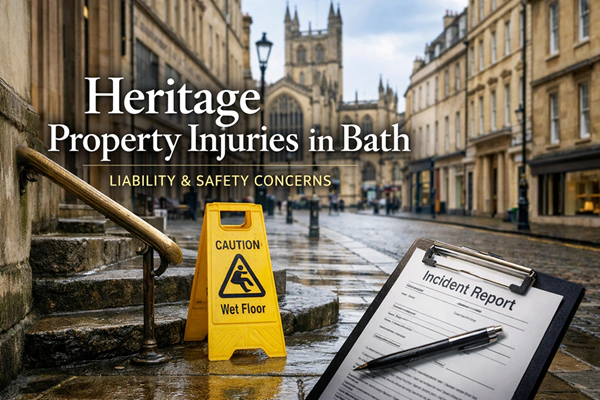
Bath’s historic streets are part of what makes the city distinctive. Georgian terraces, listed townhouses and centuries-old public buildings shape the environment in a way few places in the UK can match.
But the same features that contribute to Bath its character can also introduce risk.
Older buildings were not designed to modern safety standards. Materials age. Surfaces wear down. Structural elements shift over time. Preservation rules can prolong the presence of hazards in older properties, even when they limit changes.
This creates a situation where injuries are not uncommon, but responsibility is not always straightforward.
Why heritage buildings create unique risks
Historic properties behave differently from modern structures. What looks stable on the surface can conceal underlying deterioration.
Stone steps, for example, may appear solid but can become uneven through decades of use. Timber floors may flex or weaken. Handrails and fixtures might not meet current safety expectations. Lighting in older interiors can be inconsistent, particularly in converted spaces.
In a city like Bath, these characteristics are widespread. Visitors often move between shops, hotels, and public venues that occupy buildings originally designed for entirely different uses. Adaptations are made over time, but not always to the same standard across every property.
The result is a layered environment where risk can be subtle rather than obvious.
How liability works in historic settings
Typically, the responsibility for an injury in a heritage property hinges on the reasonable steps taken to manage known risks.
Property owners and occupiers are generally expected to maintain safe conditions for visitors. However, with listed buildings, there may be restrictions on what changes can be made. This can affect how quickly hazards are addressed or whether certain structural features can be altered at all.
That does not automatically remove responsibility.
If a hazard is known, foreseeable, and capable of being mitigated through reasonable measures, failing to act may still carry consequences. What counts as “reasonable” can vary depending on the circumstances, including the building’s status and the practicality of making changes.
This area is where claims involving historic properties often become more complex than standard slip or trip cases.
A typical scenario in Bath
A visitor enters a boutique shop operating inside a converted Georgian townhouse near the city center. The entrance steps are original stone, worn smooth over time. On a wet day, moisture is carried inside, making the surface more slippery than usual.
There is no clear warning sign, and the lighting in the entrance area is relatively low. As the visitor steps inside, they lose footing on the polished stone and fall, sustaining a wrist injury.
In this situation, the key questions are not limited to whether the fall occurred. They ask what the property operator knew about the steps, if the risk was assessed, and what was done to reduce it.
The age of the building explains the presence of the feature, but it does not necessarily explain the absence of precautions.
Where these claims become complicated
Unlike modern premises, where hazards are often easier to identify and rectify, heritage properties introduce constraints that can obscure the distinction between unavoidable characteristics and preventable risks.
One issue is that features like uneven flooring or narrow staircases may be considered inherent to the building. However, that does not remove the expectation that visitors should be able to move through the space with a reasonable level of safety.
Another factor is documentation. In some cases, maintenance records or risk assessments may not reflect the true condition of the property, particularly where changes have been made incrementally over time.
There is also the question of shared responsibility. A building may be owned by one party, leased to another, and managed by a third. Understanding who was responsible for safety at the time of the incident requires careful review.
What matters if you are injured in a historic property
The clarity of the evidence often determines the strength of any potential claim in a heritage setting.
Photographs of the hazard at the time can be valuable, especially where conditions may change quickly. Reporting the incident to the property operator creates a formal record. Witness accounts can help establish how the incident happened and whether others were aware of the risk.
It is also relevant whether similar issues had been raised before. A pattern of complaints or prior incidents may indicate that the hazard was not new.
Firms such as Marley Solicitors often handle cases where liability is not immediately obvious, particularly in environments like Bath where the age and structure of buildings play a role in how risks develop.
Why preservation does not eliminate responsibility
There is a common assumption that because a building is listed or historically protected, safety standards are somehow reduced.
That is not how the situation is typically approached.
While preservation may restrict certain structural changes, it still upholds the expectation of taking reasonable steps to safeguard visitors. Often, risks can be managed without altering the character of the building, through measures such as improved lighting, signage, surface treatments, or controlled access.
The key issue is not whether the building is old, but whether the risk was understood and appropriately managed.
Understanding the balance between character and safety
Bath’s built environment is unlikely to change in any significant way. Its historic character is central to its identity. That means the interaction between heritage and modern use will continue to create situations where risk needs to be actively managed rather than eliminated.
For individuals, the challenge is recognising that an injury in a historic property is not automatically dismissed as “just part of the building.” Each case depends on the specific circumstances, the condition of the environment, and the actions taken by those responsible for it.
Where those elements point to a preventable risk, the fact that a building is centuries old does not, by itself, resolve the question of responsibility.